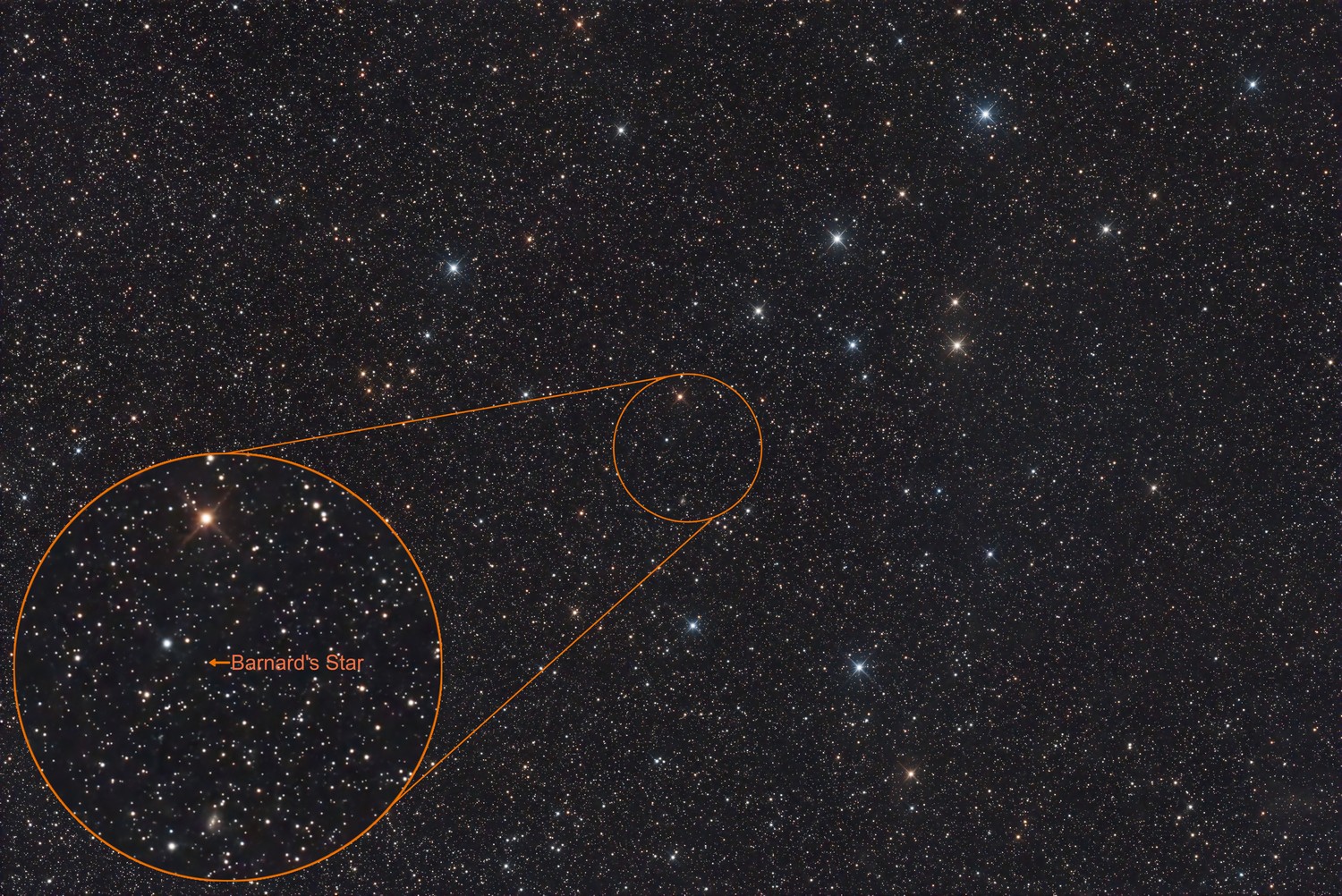
Barnard’s Star in Ophiucus

Barnard’s Star is a low-mass red dwarf star located in the constellation Ophiuchus, just 5.96 light-years from Earth. It is the fourth-nearest individual star to the Sun and the closest in the northern celestial hemisphere. Despite its proximity, the star is too dim to be seen with the naked eye, with a visual magnitude of +9.5. It is most famous for having the largest known proper motion of any star, an apparent annual movement of 10.39 arcseconds across the sky. This swift motion, first measured by astronomer Edward Emerson Barnard in 1916, is due to both its high velocity and its close distance to our solar system. For decades, astronomers have searched for planets orbiting Barnard’s Star, with a recent discovery in 2024 confirming at least one sub-Earth-sized exoplanet, Barnard b, which orbits too closely to its star to be in the habitable zone. Writen gy Gemini AI

Imaging Details

Telescope:  6 inch f/4 Newtonian with Paracorr Type 2 (effective focal length 690mm) and 2” Feather Touch Focuser

Camera:  Player One Poseidon-C Pro, Optolong L-Pro filter, Phoenix Filter Wheel 2″x5

Resolution: 1.11 arcsec/px 

Mount:  Mesu Mount 200

Guiding:  Player One OAG Max and ZWO ASI290MM Mini guide camera

Exposure Length: OSC: 300 sec x 24

Location:  Glenwood, MN

Date:  6/21/2025

Software:  SciTech, SkyGuide (Innovations Foresight), N.I.N.A., Optic FocusLynx, Pixinsight, SkySafari Pro