
TON 618 near the border of Canes Venatici and Coma Bernices
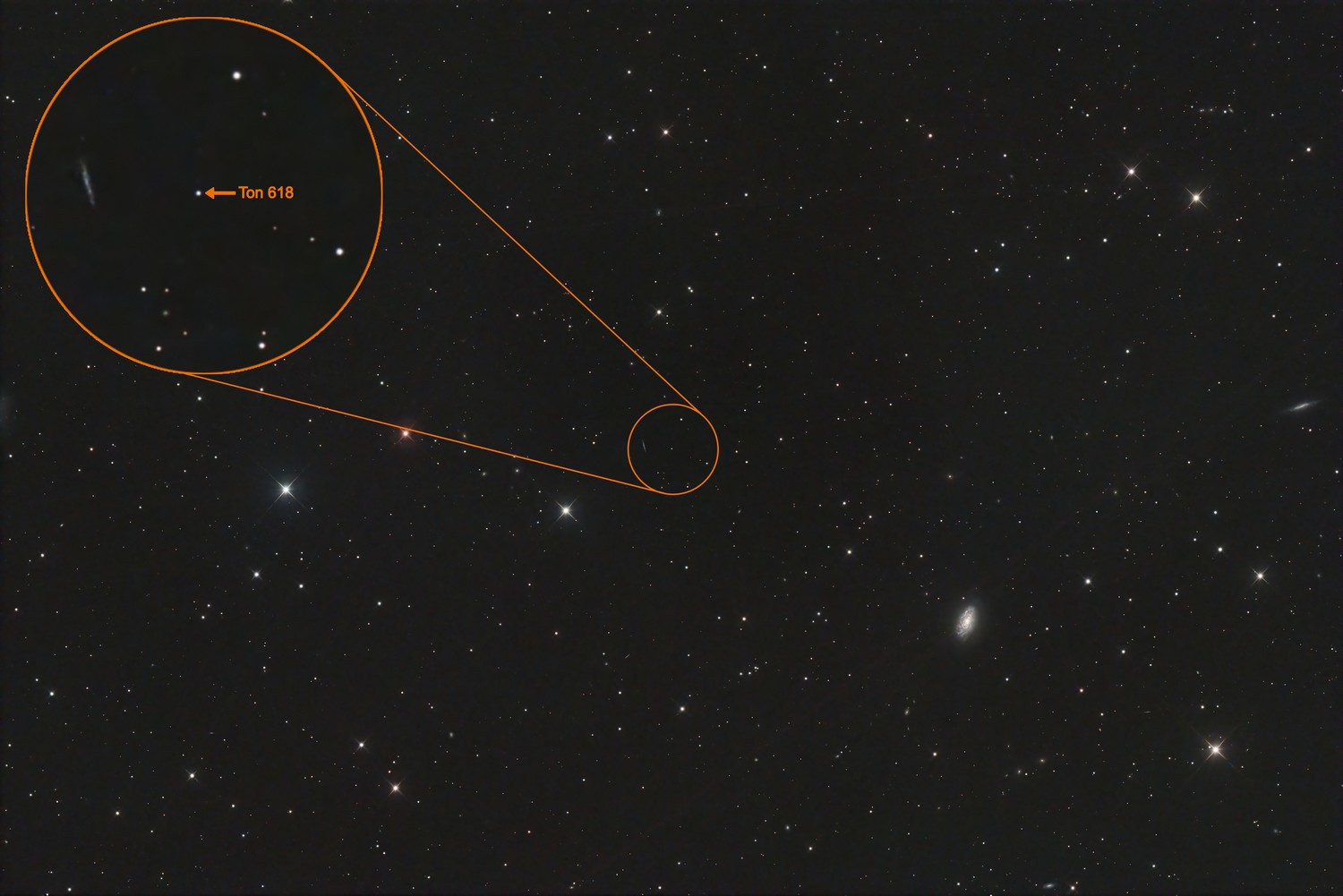
TON 618 is a hyperluminous quasar and one of the most massive black holes ever found. The central black hole is estimated to be around 66 billion times the mass of our sun, a scale so immense it’s been proposed for a new classification: an ultramassive blcak hole. The quasar’s immense luminosity—shining with the brilliance of over 140 trillion suns—is a result of matter and gas violently spiraling into the black hole. This intense radiation outshines its host galaxy, making the galaxy itself invisible to our telescopes. As a quasar, TON 618 is believed to be the active galactic nucleus at the center of a galaxy, the engine of which is a supermassive blck hole feeding on intensely hot gas and matter in an accretion disc. Given its observed redshift of 2.219, the light travel time of TON 618 is estimated to be approximately 10.8 billion years. Due to the brilliance of the central quasar, the surrounding galaxy is outshone by it and hence is not visible from Earth. With anabsolute magnitude of −30.7, it shines with a luminosity of 4×1040 ,watts, or as brilliantly as 140 trillion times that of the Sun, making it one of the brightest objects in the known universe. Gemini AI and Wikipedia.
Imaging Details
Telescope: 6 inch f/4 Newtonian with Paracorr Type 2 (effective focal length 690mm) and 2” Feather Touch Focuser
Camera: Player One Poseidon-C Pro, Optolong L-Pro filter, Phoenix Filter Wheel 2″x5
Resolution: 1.11 arcsec/px
Mount: Mesu Mount 200
Guiding: Player One OAG Max and ZWO ASI290MM Mini guide camera
Exposure Length: OSC: 300 sec x 24
Location: Glenwood, MN
Date: 6/21/2025
Software: SciTech, SkyGuide (Innovations Foresight), N.I.N.A., Optic FocusLynx, Pixinsight, SkySafari Pro