
Sh2-101 (the Tulip Nebula)
in Cygnus
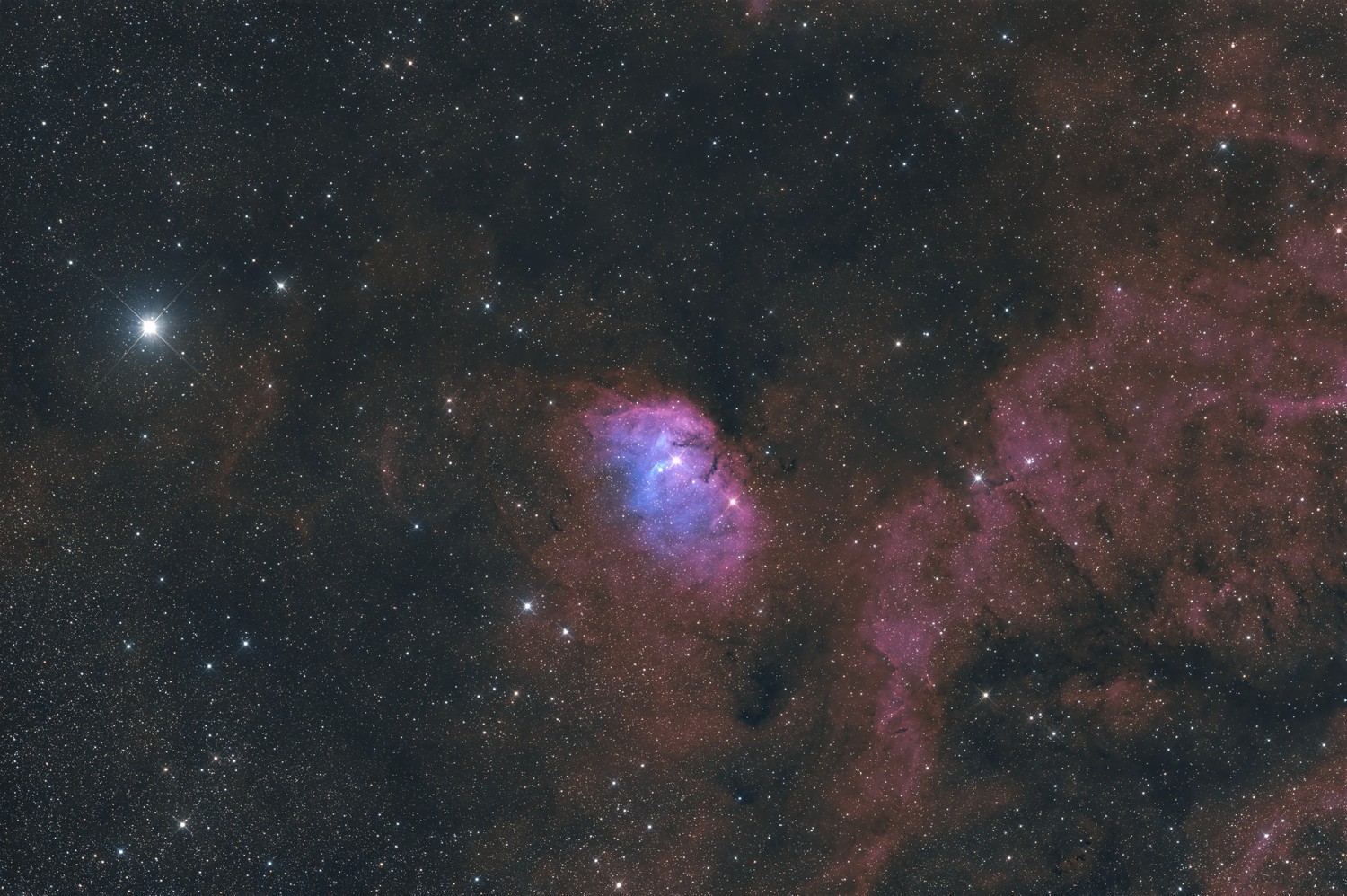
The Tulip Nebula, also known as Sh2-101, is an emission nebula located in the constellation Cygnus. Its name comes from its resemblance to a blooming tulip. The nebula’s distinct red glow is a result of hydrogen gas being ionized by the intense ultraviolet radiation from a hot, young star. That star is HDE 227018, a massive O-type star, which is believed to have once been part of a multiple-star system with the black hole Cygnus X-1. While the two objects are not physically close, Cygnus X-1’s formation likely influenced the evolution of the nebula’s surrounding gas and dust. The Tulip Nebula is part of a larger star-forming region, and it’s particularly notable for its beautiful juxtaposition with Cygnus X-1, making it a popular target for astrophotographers. Written by Gemini AI.
Imaging Details
Telescope: 6 inch f/4 Newtonian with Paracorr Type 2 (effective focal length 690mm) and 2” Feather Touch Focuser
Camera: Player One Poseidon-C Pro, Anti-Halo Pro Ha+OIII filter, Optolong L-Pro filter, Phoenix Filter Wheel 2″x5
Resolution: 1.11 arcsec/px
Mount: Mesu Mount 200
Guiding: Player One OAG Max and ZWO ASI290MM Mini guide camera
Exposure Length: HOO: 300 sec x 92, OSC: 300 sec x 16
Location: Glenwood, MN
Date: 7/19/2025, 7/24/2025
Software: SciTech, SkyGuide (Innovations Foresight), N.I.N.A., Optic FocusLynx, Pixinsight, SkySafari Pro