
M56
in Lyra
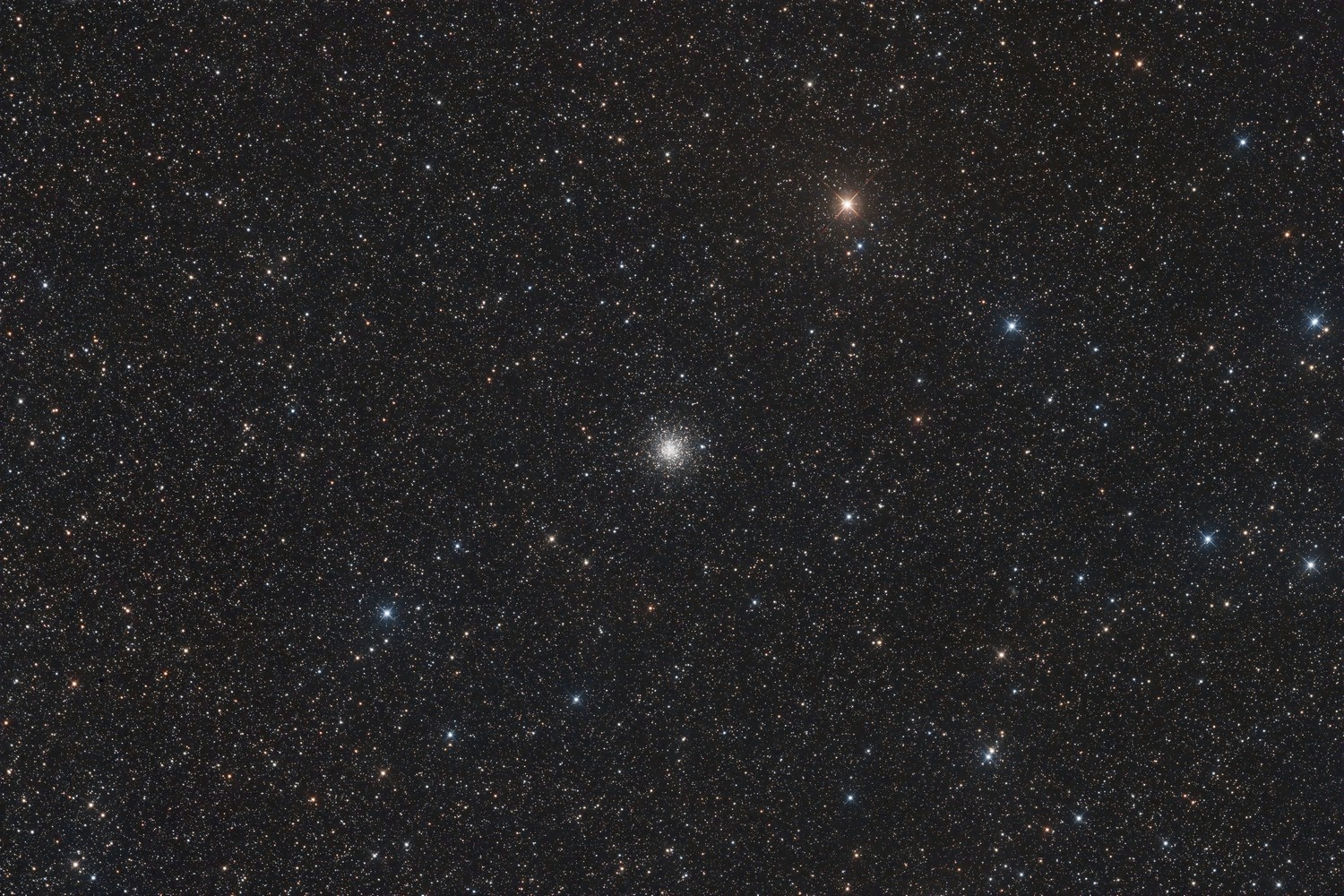
Messier 56 (also known as M56 or NGC 6779) is a globular star cluster located approximately 33,000 light-years away in the northern constellation of Lyra. It was discovered by Charles Messier in 1779 and is estimated to be roughly 13.7 billion years old, making it nearly as old as the universe itself. Spanning about 84 light-years in diameter, M56 is home to approximately 230,000 solar masses, yet it lacks the highly compressed, bright core typical of many other globular clusters, leading to its classification as a Class X cluster on the Shapley-Sawyer scale.
Interestingly, M56 follows a retrograde orbit through the Milky Way, moving in the opposite direction of most stars in our galaxy. Astronomers believe this is because M56 was not originally part of our galaxy but was instead “captured” from a satellite dwarf galaxy—likely the Gaia Sausage—during a massive galactic merger billions of years ago. Visually, M56 sits about midway between the bright stars Albireo and Sulafat, appearing as a faint, fuzzy star in binoculars, while a telescope of at least 8 inches is required to resolve its individual ancient members into a sparkling swarm. Written by Gemini AI.
Imaging Details
Telescope: 6 inch f/4 Newtonian with Paracorr Type 2 (effective focal length 690mm) and 2” Feather Touch Focuser
Camera: Player One Poseidon-C Pro, Optolong L-Pro filter, Phoenix Filter Wheel 2″x5
Resolution: 1.11 arcsec/px
Mount: Mesu Mount 200
Guiding: Player One OAG Max and ZWO ASI290MM Mini guide camera
Exposure Length: 60 sec x 70
Location: Glenwood, MN
Date: 9/15/2025
Software: SciTech, SkyGuide (Innovations Foresight), N.I.N.A., Optic FocusLynx, Pixinsight, SkySafari Pro